
Carlo Brescia Seminario
Cineasta investigador
Carlo Brescia is a Peruvian filmmaker, writer and researcher who lives in Huaraz. He directs the cultural association Vasos Comunicantes and the magazine Culturas Sustentables desde la Peripheria. His research explores Andean culture and body awareness through audiovisual projects and publications. This article is an approach to Chavín de Huántar from a personal perspective spanning more than twenty years
Chavín, a temple of duality and of the great human mystery
By Carlo Brescia Seminario
More than 3000 years ago, a site existed in the middle of the Andean mountains of Peru that brought together people of different cultures, places and languages: Chavín de Huántar. The name comes from the Ancash Quechua word Chawpin, which means “its center”. And indeed, Chavín was a ceremonial center that emerged and flourished, according to the consensus among researchers, between the 12th century BC and the 4th century BC, that is, for some eight hundred years.
The first time I heard about Chavín was in elementary school in Lima. One or two years later, still in elementary school, I visited this ancient temple when I was 12 years old, in 1985. I visited it again in 1994, but I was still not ready to understand what I was seeing. How could I have been? At the time, all my experience and almost my entire life were based on the experiences of a middle-class child living in one of the South American capitals, where the hegemonic stance was to celebrate Western culture and to develop negative prejudices toward all things indigenous, especially all things Andean.
Chavín de Huántar is a temple with several buildings constructed of carved stone between two rivers, the Mosna and the Huachecza, covering almost 15 hectares. What makes it stand out are several material elements or components, architectural and otherwise, that can still be appreciated today, and, based on this evidence, the interpretive theories about the importance of this place.
First, inside the buildings and beneath the plazas, the network of channels, passageways, stairways and chambers, often superimposed, known as the underground galleries of Chavín, stands out. Their total cumulative length is estimated to be around 3 kilometers. Thanks to ventilation shafts between the different galleries and the outside, it is possible to breathe easily. By day, these shafts bring a little light inside, while at night, without artificial light, the galleries are completely dark.
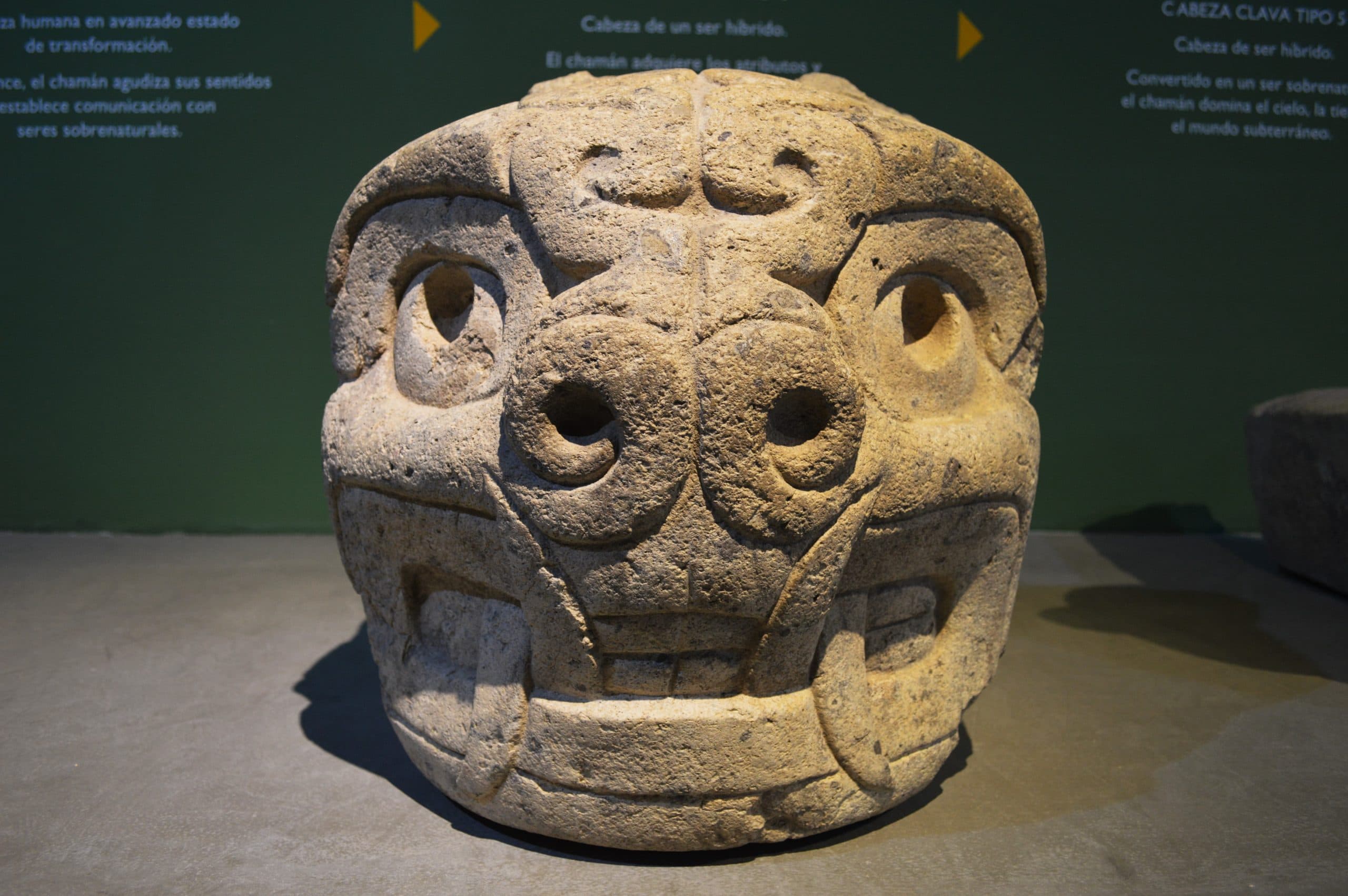
Second, Chavín is notable for its monolithic sculptures carved in low relief (stelae, cornices, columns and lintels) and in the round (more than 150 tenon heads) that form part of the temple's architecture, visible to anyone who came close enough to them. These sculptures record complex designs of anthropomorphic beings and animals (falconids, snakes, felines, bats). For example, the complex designs may be beings of human form, with wings, feline fangs or serpent hair, or beings of animal form, such as a feline whose volutes on its back are shaped like snakes.
Third, something even more remarkable than what was mentioned in the two previous points is the presence of a carved sculpture 4.5 meters tall located in the most important gallery of the temple, the Lanzón gallery. Today many people, including tour guides, teachers and researchers, call the sculpture the Lanzón Monolith. Personally, I prefer to use the name given to it by the local population more than 140 years ago, a name recorded by Ernst Middendorf: the Huanca. A huanca is an elongated carved monolith placed vertically. There are many huancas, but the one at Chavín is special because of the designs on its surface, its orientation and its location. The designs show an anthropomorphic being with animal features (feline fangs, serpent-shaped eyebrows) with its right hand raised and its left hand pointing down. It is oriented toward the sunrise, the east. And it is located at the center of a cross-shaped gallery, showing the perceptive observer an in situ example of what an axis mundi is: a center of union between the sky, the earth and the underworld.
There are other notable components or features, such as the presence of the Raimondi stela and the Tello obelisk, sculptural pieces that are emblematic not only of Chavín and the Andean world, but of the Americas and perhaps of the world. The first, the Raimondi stela, shows a figure that centuries later is represented in a similar way in cultures such as Nasca, Wari and Tiwanaku. The second, the obelisk, is a 2.5-meter prism carved on its four sides with what appears to be a mythical narrative, similar to the ones recorded on the totem poles of the cultures of the North American Northwest.
Likewise, it is remarkable that the temple was built following a north-south orientation and that the square plaza or the circular plaza of the temple align with the sunrise during the December and June solstices through a small altar located in the eastern mountain range, called Piruru hill.
Finally, a notable feature is the apparent message conveyed through the architecture and the iconography on the stone sculptures and some ceramics. A message that follows a human, perhaps cosmic, principle of wisdom: that of complementary opposition in balance. The American anthropologist Richard Burger argued in 1992 that the architecture of the Portal of the Falconids in the New Temple of Chavín incorporates the Andean principle of balance between opposing and complementary dualities: Yanantin. He also finds it in the Black and White Staircase, and in stelae such as the Medusa stela, among others.
The term Yanantin is not only complementary duality: it implies balance between those polar relationships. Balance refers to the point of harmony between two opposing elements; it is the midpoint, equidistant, since imbalance is an excess of weight, force, energy or presence of one of the two elements. Therefore, Yanantin can be understood as a mediation of opposites, in Burger's words: “The temple of Chavín de Huántar presented itself as a cosmic center where opposites were mediated and balance was maintained through proper religious ceremonies and the esoteric knowledge of its religious leaders”.
In 2005, after finishing a master's degree in social sciences, I began a personal study of Chavín, seeking to understand how, during a period of eight centuries that began 3200 years ago, the world was ordered in such a way that different cultures formed an exchange network, shared a worldview and developed the social, technological and symbolic pillars of the Andean world known at the time, whose center was Chavín, a pilgrimage destination and the beginning of a message that still resonates today.
That curious journey led me to try to understand the meaning behind the use of several master plants, such as the San Pedro cactus (also called Wachuma, Lapituq and Tsunaq), the Willka tree (also called Cebil), and coca and tobacco leaves. This is because at the temple of Chavín de Huántar there is iconographic evidence of the use of the cactus and archaeobotanical evidence of Willka and tobacco. What was the meaning of the ritual use of these plants in the Chavín phenomenon? What was happening in the different rituals carried out at the temple?
After more than 20 years, I think I have understood a little. What I am sure I have understood is that the people who built the temple were very wise human beings and, for that very reason, deeply connected with that more-than-human world. At Chavín, as I tell the people I bring and guide through the temple, rather than an encounter with an ancestral civilization, it is a potential encounter with what being human truly is, with what makes us who we are. Chavín is a mirror, a flame of light, the same as that of the Huanca in its most sacred gallery, the one we call Wari Wanka (‘the huanca that gives light’), which reminds us where we come from, where we are and where we need to go.
To learn more about the activities he organizes and his publications, visit this link: